Singapore vs. Heat: The Lessons India Is Ignoring That Are Costing Lives
Ramesh is a construction worker in Nagpur. He starts at 6 a.m. because by noon, the iron rods he carries are too hot to touch with bare hands. His lunch break is spent under a tree — the only one on the site. In May 2024, a colleague collapsed two streets away. He didn’t make it. Ramesh doesn’t know about Singapore. But Singapore knows about people like Ramesh — and it has spent decades building a city so that workers, grandmothers, and schoolchildren don’t die just because it’s summer.
A Nation That Decided Not to Accept the Heat
There is a particular cruelty to dying of heat. It is slow, invisible, and preventable. You don’t see it coming the way you see a flood or hear a storm. One moment you’re sweating, your head hurts, the world swims a little — and if nobody notices in time, that’s it.
India has been watching this happen for years. Between April and June 2024, at least 733 people died from heat across 17 states — and that’s just what researchers could confirm through media reports. The government counted 360. The real number, as doctors quietly acknowledge, is almost certainly higher, because most heat deaths in India are attributed to other causes: “heart failure,” “exhaustion,” “old age.” The heat is invisible even in death.
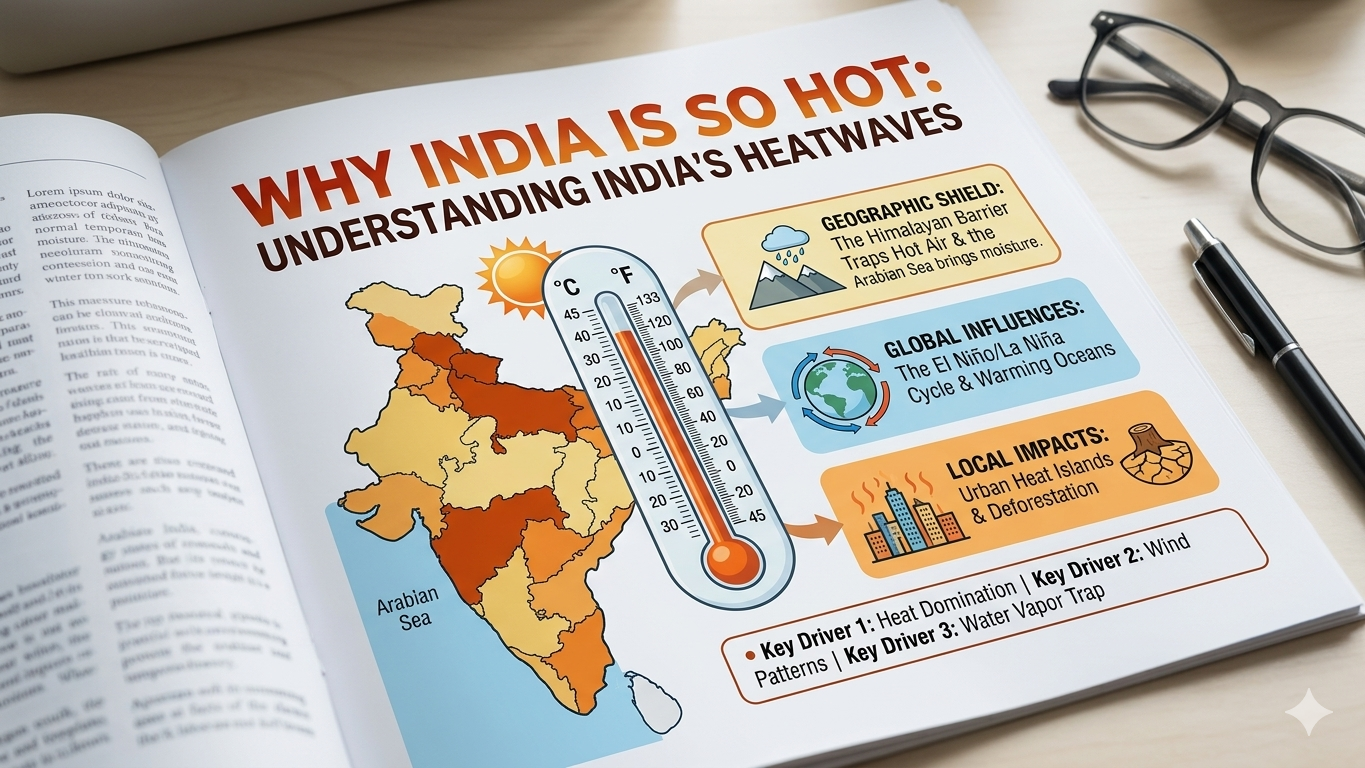
That same year, 37 Indian cities crossed 45°C. Churu in Rajasthan hit 50.5°C — hot enough to fry an egg on the pavement. In 2025, the heatwave arrived in April, weeks ahead of schedule, and Sri Ganganagar in Rajasthan touched 48°C in June. Hundreds died before the monsoon brought relief.
Now look at Singapore.
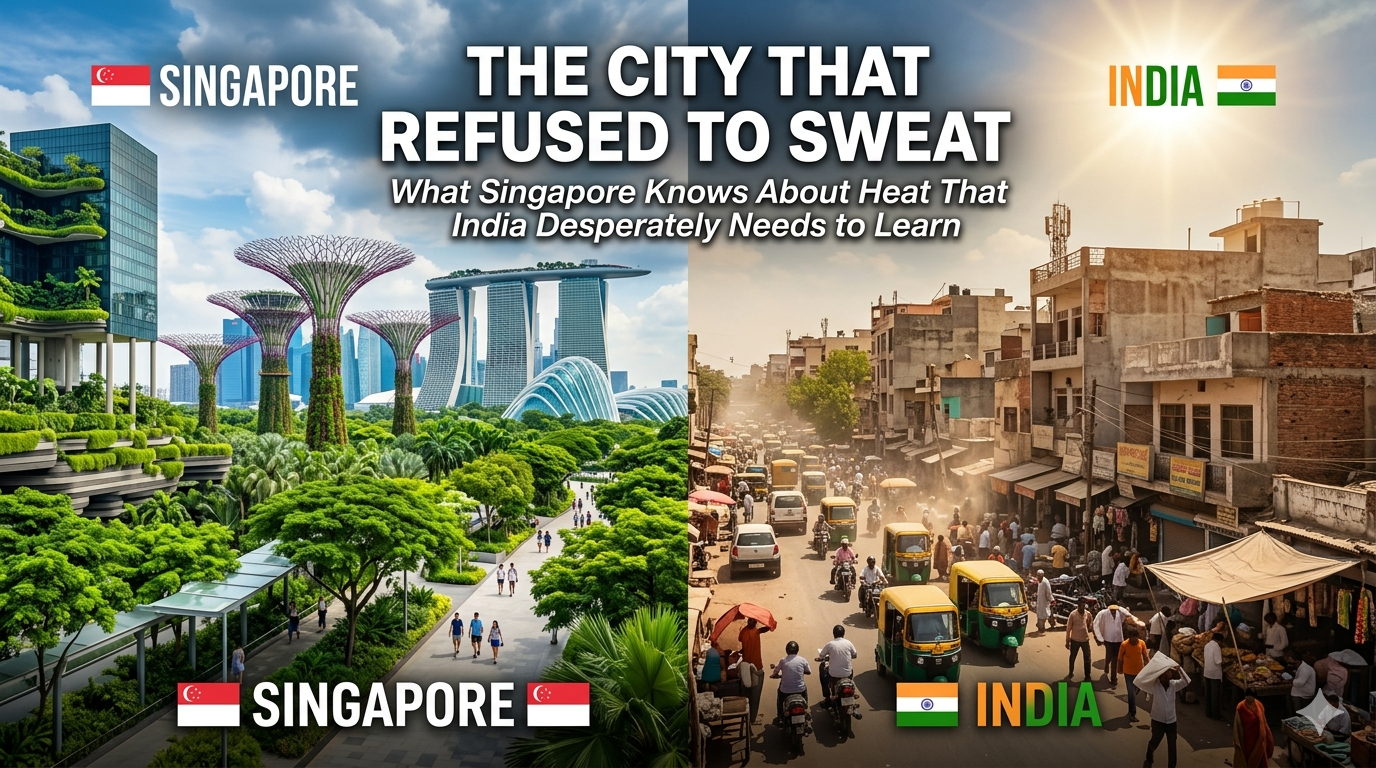
Singapore sits just 1.3 degrees north of the equator. It has no winter. It is denser, more concrete-packed, and more vertical than almost any Indian city. In 2023, it recorded its highest temperature in 40 years — 37°C. Scientists estimate it endured 122 extra days of dangerous heat in 2024 alone due to climate change. By any geography, Singapore should be suffering. Instead, it has become one of the most studied cities in the world for how to keep people cool.
The difference isn’t luck or latitude. It is choices — made over decades, written into law, funded by government, and designed into the very bones of the city. And those choices have something urgent to say to India.
Singapore’s Playbook: Six Things That Actually Work
1. They Planted a Forest in the Middle of Their City — and Meant It
When Lee Kuan Yew founded modern Singapore, he had one obsession that seemed almost eccentric for a newly independent nation: trees. He wanted every road lined with them, every building surrounded by them, every bit of spare ground planted over. Colleagues thought he was distracted. He was right.
That “Garden City” vision has since grown into something much more ambitious — the Singapore Green Plan 2030, which commits to adding 1,000 hectares of new green space and ensuring every resident is within a 10-minute walk of a park by the end of this decade.
This isn’t just aesthetics. Trees are actually cooling machines. They cool the air around them through a process called evapotranspiration — essentially, they sweat, just like we do, and that releases heat from the environment. Research shows that green infrastructure in dense cities can bring down air temperatures by up to 2.6°C and surface temperatures by 11°C. In a city where stepping out of the shade into the sun is the difference between comfort and a heatstroke, those degrees matter enormously.
2. They Ran Out of Ground — So They Went Up
Singapore has 733 square kilometres. It cannot keep spreading outward. So it grows upward — including its greenery.
Since 2009, the government has been paying developers to put gardens on their rooftops and hang plants down their walls, through a scheme called LUSH (Landscaping for Urban Spaces and High-Rises). Today, Singapore has over 100 hectares of rooftop gardens and green walls — more than Chicago, which had long been the world leader in green roofs.
The public housing board — the HDB — which houses roughly 80% of Singaporeans (imagine if India’s government housing board worked at that scale and quality), has been installing rooftop gardens on multi-storey car parks since 2006. They even developed their own lightweight rooftop planting system, the PEG Tray, that any building can bolt on. By 2030, they aim to have 200 hectares of rooftop greenery across public housing estates.
The result isn’t just cooler temperatures. Buildings with green walls use 10–31% less energy to cool themselves. For a country like India that’s buying air conditioners faster than any nation on earth, that figure deserves a long look.
3. They Made the Streets Themselves Reflect Heat Away
Here’s something most people don’t think about: the reason cities are so much hotter than the countryside isn’t just buildings — it’s the surfaces. Black asphalt, dark concrete, metal rooftops — they absorb the sun all day and release that heat through the night, turning cities into slow-burning ovens.
Singapore is fighting this too. The city uses cool pavements and reflective roof coatings engineered to bounce solar radiation back instead of absorbing it. These high-reflectance surfaces can reduce ground temperatures by 4–9°C — a difference you feel immediately underfoot and in the air around you.
At Clarke Quay, Singapore’s famous riverside district, they rebuilt the overhead canopies using a material called ETFE — think of it as a clever plastic membrane that lets in light but blocks heat. The result: it feels 2.5°C cooler standing underneath, and the ground surface temperature drops by 8°C. Eight degrees, just from a smarter canopy.
4. They Designed Their City to Let the Breeze Through
Walk through an old Indian city — Varanasi’s ghats at dawn, the old quarters of Ahmedabad — and you’ll often find a surprising coolness, even in May. Those cities were built for breeze. Narrow lanes funnelled air. Thick walls stored coolness. Courtyards created updrafts that ventilated entire neighbourhoods.
Modern cities have forgotten this. Singapore hasn’t. Urban planners there deliberately design wind corridors — gaps between buildings, oriented along prevailing winds, that funnel breezes through the city like ventilation shafts. The city maps its own airflow before approving any major development. Buildings are positioned and sized so they don’t create dead zones where heat accumulates.
This doesn’t cost money. It costs discipline — the kind that needs to be written into planning rules before the developer’s concrete is poured.
5. They Share the Cold
Air conditioning is necessary in a hot city. But the way most cities run it — every building with its own rooftop unit, rattling away, pumping warm air into the street — creates a vicious cycle. The more you cool your building, the hotter you make the street, the more your neighbours need cooling, the hotter everything gets.
Singapore broke this cycle in parts of the city with district cooling — giant centralised chilling plants that produce cold water and pipe it to dozens of buildings at once. It’s more efficient, cheaper to run, and critically, it dumps far less waste heat back into the city air. It’s invisible to the people who benefit from it. And in Singapore’s Marina Bay area, it works.
6. They Built a Digital Twin of the Entire City’s Heat
This one sounds like science fiction, but it’s real and running. Singapore has built a Digital Urban Climate Twin — a computer model of the entire city that simulates heat, airflow, traffic, land surface, and atmosphere together. Planners can test what happens if they plant 10,000 trees in a particular neighbourhood, or what the temperature effect is of changing road surfaces in the central business district — all before spending a single dollar.
It’s heat policy powered by the same logic that pilots use flight simulators: figure out what works before you do it in the real world.
Back to India: The Cost of Not Acting
In 2024, 33 election workers died on polling duty from heatstroke. They were serving their democracy. They died because nobody arranged shade or cooling at their stations. That same year, the Lancet noted India had seen a 55% rise in heat deaths over the previous two decades. In 2021, heat caused Indians to lose 167 billion hours of potential work — farmers who couldn’t keep going, labourers who had to stop, productivity that simply evaporated in the sun.
India does have Heat Action Plans in most major cities. Ahmedabad’s, launched in 2013, is genuinely good — it has been credited with saving over 1,000 lives a year. On bad days, clinics activate protocols, ambulances carry ice packs, and construction workers shift their hours. But the honest assessment of India’s plans across the country is sobering: most of them are emergency health responses dressed up as climate strategy. They train doctors. They track deaths. They don’t redesign cities.
As one researcher put it: “You end up with greenery on the outskirts, not where it’s needed.”
The poorest neighbourhoods — where tin-roofed homes turn into furnaces, where power cuts mean no fan, where the nearest tree is a kilometre away — are precisely the places left out of India’s cooling efforts, because land ownership is complicated, because infrastructure is harder, because nobody powerful enough lives there to demand it.
What India Can Actually Do — Starting Now
Put the trees where the people are. Not on the ring road outside town. In the courtyards of public housing in Bhopal. On the walls of government schools in Patna. Along the lanes in Dharavi. Singapore showed that greenery placed strategically in dense areas is what keeps temperatures liveable. India’s tree-planting drives are impressive in numbers and disappointing in placement.
Paint the poor neighbourhood’s rooftops first. Reflective cool roof coatings are cheap, they work, and several Indian NGOs are already proving it in slums. A subsidised national programme to coat the tin and concrete rooftops of India’s 65 million informal households with heat-reflective paint would be among the most cost-effective public health interventions this country has ever run.
Bring back what we already knew. The jali. The chhajja. The deep verandah. The interior courtyard. Indian builders figured out passive cooling centuries ago. The Stepwells of Gujarat, the havelis of Rajasthan, the wind-catchers of the Deccan — all of these worked without a single kilowatt. Modern building codes have let this knowledge die. New codes should mandate at least some of these features in all new construction.
Design for wind, before the concrete sets. Every new township, every Smart City project, every residential layout should be required to show how it will preserve airflow. This is not expensive. It is planning. It needs to happen before the buildings go up, not after.
Start district cooling in the Smart Cities. India is building new urban precincts under its Smart Cities Mission in 100 cities. Bhopal, Pune, Surat, Naya Raipur — places that are growing fast enough to do this right. Building district cooling in from the ground up in even a few of these cities would demonstrate what’s possible and what it costs.
Make heat everyone’s problem, not just the health ministry’s. The deepest lesson from Singapore isn’t any single technology. It’s that heat is a planning problem as much as a health problem. It belongs in building codes, master plans, road design standards, and housing policy — not just in heatstroke protocols. Until India’s urban planners, not just its doctors, are responsible for reducing heat deaths, the deaths will continue.
The Choice in Front of Us
There’s a story from Singapore about an elderly woman during a 2024 heatwave who couldn’t rest on a public bench — the metal was too hot to sit on. That image prompted an entire community committee to redesign their precinct’s public spaces. A single uncomfortable woman catalysed real change.
India has millions of Rameshs — workers who start before dawn, rest under the only tree on the site, and carry water they can’t always afford. It has grandmothers on tin-roofed verandahs in May. Children at government schools with no shade in the courtyard. Farmers who must choose between heat and income.
Singapore, with a fraction of India’s resources and a fraction of India’s land, chose to take heat seriously as a civilisational problem — not a seasonal annoyance, not a health emergency to be managed annually, but a design flaw in how cities are built, to be corrected permanently.
India has every advantage Singapore didn’t: ancient architectural wisdom, a living tradition of climate-sensitive building, and cities young enough that many of them can still be shaped before they’re set in concrete.
The planet is getting hotter. That part isn’t a choice. What we build — and for whom — still is.
Sources: HeatWatch India, Down to Earth, World Bank, Singapore COP29 Pavilion, HDB Green Towns Programme, The Lancet, Cooling Singapore 2.0 / ETH Zurich, Wikipedia heatwave records, Eco-Business Asia, CEEW India Climate Collaborative.