
Building a Safer India: Smart Strategies to Reduce Crime Effectively
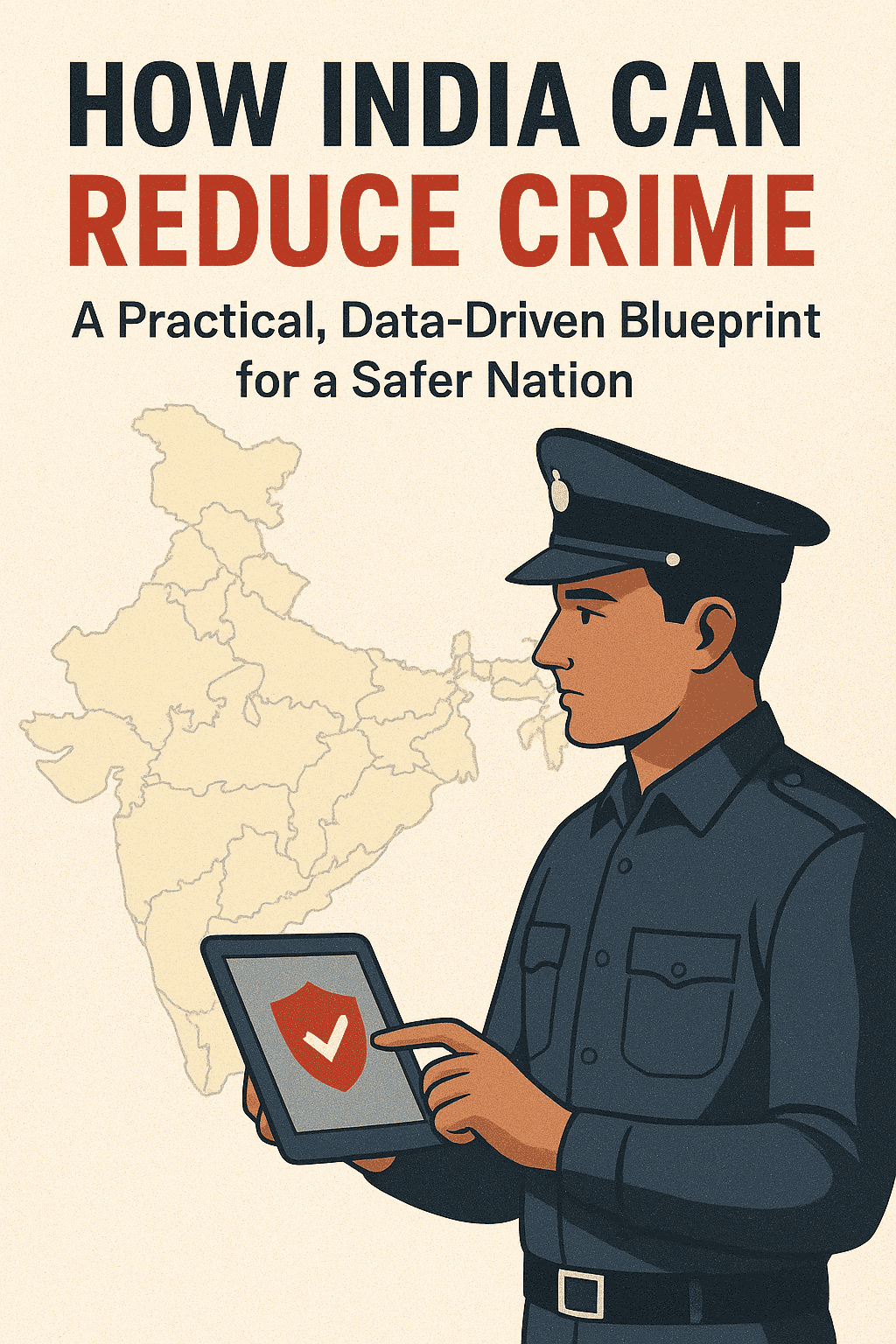
Introduction — why this matters
Crime touches every corner of India: cities and small towns, households and online lives. Beyond the immediate human cost, persistent crime erodes trust in institutions, hurts investment and tourism, and diverts public resources away from development. Reducing crime isn’t just about tougher punishment — it’s about smarter prevention, faster justice, better policing, social investments and community partnerships. This blog lays out a comprehensive, evidence-based plan India can follow — combining what works globally with Indian examples, backed by recent data and official programmes.
Where we stand: the facts (short and sharp)
Recent official data and analyses show the scale and changing shape of crime in India. The National Crime Records Bureau (NCRB) reported that total cognizable crimes rose to about 6.24 million cases in 2023 (a roughly 7.2% increase over 2022) and the national crime rate increased to 448.3 per 100,000 population. Traditional violent crimes show mixed trends (some declining), while cybercrime and many urban offences are rising rapidly. (NCRB / Crime in India 2023 summaries). VISION IAS+1
Other concrete facts that shape policy choices: conviction and disposal patterns remain a challenge, while targeted judicial innovations such as Fast Track Special Courts (FTSCs) for sexual offences and POCSO cases have shown high disposal rates where implemented — highlighting how judicial capacity can change outcomes when properly resourced. Press Information Bureau+1
Why crime rises (root causes, briefly)
-
Socioeconomic drivers — poverty, inequality, unemployment and lack of opportunities push some toward property and economic crimes.
-
Rapid urbanisation and poor city design — crowded, poorly lit public spaces create opportunities for theft, assault and road-based crimes.
-
Weak institutional capacity — understaffed police, poor forensic capacity, low reporting rates and delayed trials reduce deterrence.
-
Digital transformation — the shift online has produced a surge in fraud, phishing and cyber-enabled crimes that traditional policing struggles to handle.
-
Social breakdowns — family stress, substance abuse and lack of mental health support contribute to interpersonal and violent crimes.
Understanding causes matters because most successful crime reduction programmes act before crimes happen (prevention), rather than only after.
A multi-pronged roadmap to reduce crime
No single reform will do it. A combination of policing, justice, social, technological and urban interventions is necessary.
1) Modernise policing — smarter, faster, transparent
What to do
-
Invest in police infrastructure: equipment, forensic labs, digital case-management and body cameras.
-
Expand and fully operationalise the Crime and Criminal Tracking Network & Systems (CCTNS) so police stations have integrated records, quicker checks and inter-state information sharing.
-
Strengthen investigative training and forensic capacity (DNA labs, ballistic analysis, cyber forensic units).
Why it works
Modern tools and trained investigators shorten investigations, increase charge-sheeting and improve conviction rates — all of which strengthen deterrence and public trust. The central government’s Police Modernisation schemes and projects such as CCTNS are designed for exactly this purpose. Ministry of Home Affairs+1
2) Community policing and public partnerships
What to do
-
Roll out formal community-police partnerships nationwide: police-community meetings, local advisory boards, neighbourhood watch and school outreach.
-
Train officers in communication, de-escalation and local problem solving.
-
Use volunteers/NGOs for victim support and awareness campaigns.
Why it works
Community policing shifts the relationship from adversarial to cooperative: citizens provide local intelligence, police become more approachable, and social problems are handled before they escalate. UN agencies and Indian policy analyses emphasise locally-rooted prevention as a cost-effective method for crime reduction. Pilot programs and academic reviews show improved police–public relations where community policing is implemented. Drishti IAS+1
3) Speedy, accessible justice — reduce impunity
What to do
-
Expand Fast Track Special Courts for priority crimes (sexual violence, crimes against children, cybercrime where possible) while reforming case-management in regular courts.
-
Digitise court records and hearings to cut adjournments; provide legal aid and victim-friendly procedures (in-camera testimony, support persons).
-
Strengthen plea bargaining and alternate dispute resolution for appropriate non-violent cases to free court capacity.
Why it works
Swift justice increases deterrence and improves victim confidence — faster disposal reduces pendency and backlog. FTSCs have shown high disposal rates in many places when adequately resourced, proving the value of targeted judicial capacity. At the same time, FTSCs must be integrated with police and victim support systems to deliver real justice. Press Information Bureau+1
4) Targeted crime prevention through environment and design (CPTED)
What to do
-
Use Crime Prevention Through Environmental Design (CPTED) in urban planning: better lighting, clear sightlines, safe public transport access, designated walking routes and maintained public spaces.
-
Identify and fix local “hotspots” using police data — then deploy focused interventions (lighting, CCTV, door-to-door outreach, youth programmes).
Why it works
Situational prevention (reducing opportunities) is often cheaper and faster than social engineering. UNODC and crime prevention manuals list environmental design, target hardening and community audits as proven steps. UNODC
5) Tackle cybercrime with specialised units and public education
What to do
-
Expand cybercrime cells with trained investigators and rapid response; standardise reporting portals and victim assistance.
-
Run nationwide digital literacy and fraud-awareness campaigns, focusing on older citizens and small businesses.
-
Partner with banks, platforms and telecoms to speed freeze/trace of funds and block fraudulent numbers/accounts.
Why it works
The online nature of modern fraud needs technical response plus prevention: victims who know the signs are less likely to fall prey, and rapid tech-enabled responses can preserve evidence and recover funds. Recent NCRB and state reports show cybercrime surges in many states, making this a priority. The Times of India+1
6) Social investments — education, jobs and rehabilitation
What to do
-
Invest in early-childhood education, vocational training and youth employment schemes in high-crime areas.
-
Expand counselling, substance-abuse treatment and community mental-health services.
-
Implement evidence-based rehabilitation programmes in prisons (education, skill training) and community reintegration for low-risk offenders.
Why it works
Most property and non-violent crimes are linked to economic desperation and social exclusion. Social investments reduce the supply side of crime by giving alternatives and addressing root causes. Rehabilitation cuts recidivism and long-term cost.
7) Victim services — reporting, protection, compensation
What to do
-
Create one-stop victim assistance centres (medical, legal, psychological) near major hospitals and police stations.
-
Simplify reporting and ensure anonymity/protection options where needed.
-
Strengthen compensation and witness protection schemes for serious crimes.
Why it works
When victims trust the system and get support, reporting rises — which helps law enforcement detect and deter networks — and survivors are less likely to be re-victimised.
8) Evidence, data and accountability
What to do
-
Publish open crime dashboards at city and district level (anonymised) so communities can see trends and hotspots.
-
Hold regular public performance reviews of police stations based on clearance, response time, conviction support and community satisfaction.
-
Use randomized evaluations to test new programmes before scaling.
Why it works
Transparency builds accountability and helps allocate resources where they matter most. Data-driven approaches (hotspot policing, predictive resource allocation) have shown results when used ethically.
Implementation: sequencing and practical steps
-
Pilot + evaluate: Start pilots in a few high-need districts combining community policing + CPTED + fast-track court linkages. Use rigorous monitoring.
-
Scale technical backbone: Finish nationwide CCTNS linking police stations, forensics and courts. Expand cyber cells. (This is core infrastructure.) digitalpolice.gov.in
-
Invest in people: Train police in investigation, de-escalation and community engagement; hire social workers and counsellors.
-
Urban safety plans: Cities must adopt safety audits and apply CPTED principles in new projects. UNODC tools and guidelines can guide municipal plans. UNODC+1
-
Legal & judicial synchrony: Synchronise police, prosecution and FTSC capacity; ensure victim support is operational at the same time as courts accept cases. Press Information Bureau
Common objections and trade-offs
-
“Tougher laws will fix it.” Not by themselves. Laws matter, but enforcement capacity, evidence quality and speedy trials determine whether laws deter crimes.
-
“More surveillance (CCTV) invades privacy.” Use privacy-respecting policies: public notice, data minimisation, retention limits and independent audits. Technology needs legal guardrails.
-
“We can’t afford all this.” Prioritise low-cost, high-impact measures first: lighting, community policing, targeted FTSC expansion and digital reporting. Evidence suggests many prevention measures are cheaper than the long-term social costs of crime.
Examples and evidence from India (short)
-
Fast Track Special Courts: Where resourced, FTSCs have shown high disposal rates for sexual-offence cases, demonstrating the impact of judicial capacity when linked to victim services. Press Information Bureau+1
-
Police Modernisation & CCTNS: Central initiatives exist to modernise forces and connect police records — completion and adoption at state level yields better investigations and cross-border tracking. Ministry of Home Affairs+1
-
Community policing pilots and academic studies: Indian pilots and international evidence both stress that community trust dramatically improves information flow and crime prevention. SAGE Journals+1
Concrete, ready-to-adopt checklist for policymakers (short)
-
Finish national CCTNS integration and fund state forensic upgrades. digitalpolice.gov.in
-
Expand FTSCs for high-priority categories and link them with one-stop victim centres. Press Information Bureau
-
Mandate community policing cells in every police station; allocate small grants for local safety audits. Drishti IAS
-
Launch nationwide cyber-fraud awareness + streamline a single portal for cybercrime reporting. The Times of India
-
Require municipal safety audits and CPTED principles in urban planning. UNODC
Conclusion — the practical vision
Reducing crime in India is achievable — but only if we treat it as a systems problem: policing, courts, urban design, social welfare and technology must work together. Quick fixes and headline laws won’t be enough. Instead, scale proven prevention (community policing, CPTED), modernise detective and forensic capacity, speed up justice where victims need it most, and invest in the social services that address root causes.
The payoff is enormous: safer streets, stronger communities, more investment, and lives saved. With focused pilots, honest measurement, and political will, India can cut crime significantly in the next decade — not by repression alone, but by designing safer systems that prevent crime before it happens.
Sources & further reading (key references)
-
National Crime Records Bureau — Crime in India 2023 (summaries & press coverage). VISION IAS+1
-
Ministry of Home Affairs — Police Modernisation Division & Modernisation of State Police Forces scheme. Ministry of Home Affairs+1
-
Crime and Criminal Tracking Network & Systems (CCTNS) project overview. digitalpolice.gov.in
-
UNODC — Crime prevention guidelines and community-based prevention resources (handbooks). UNODC+1
-
Government of India press notes on Fast Track Special Courts and evaluations. Press Information Bureau+1