
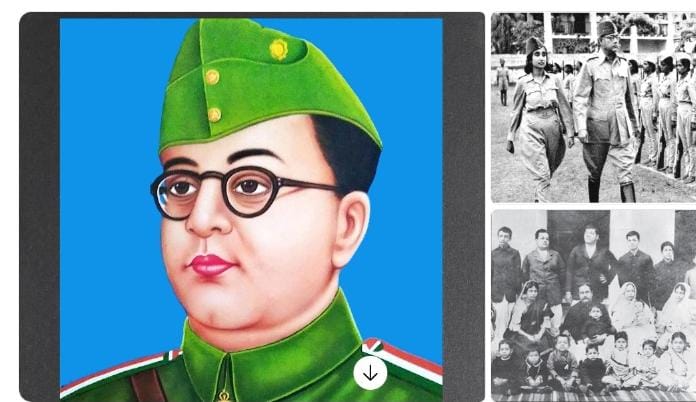
Introduction: A Legend Beyond Time
When history speaks of India’s freedom struggle, one name echoes louder than most — Netaji Subhas Chandra Bose. His courage, intellect, and undying spirit continue to inspire generations long after his mysterious disappearance. Born on 23 January 1897 in Cuttack, Odisha, Netaji wasn’t just a revolutionary; he was a visionary who believed that India’s independence required not negotiations, but action.
Unlike many leaders who pursued peaceful protest, Bose’s path was different. He believed in the words he once roared to his followers —
“Give me blood, and I will give you freedom.”
This one sentence captures the essence of his life: a man willing to sacrifice everything for his motherland.
Early Life and Education: From Scholar to Revolutionary
Subhas Chandra Bose was born into a wealthy and well-educated Bengali family. His father, Janakinath Bose, was a respected lawyer, and his mother, Prabhavati Devi, a deeply religious woman. From childhood, Subhas displayed intelligence and discipline, attending the prestigious Ravenshaw Collegiate School and later Presidency College, Calcutta.
After excelling academically, he went to England in 1919 to prepare for the Indian Civil Service (ICS) examination. In 1920, he successfully passed the exam — a remarkable feat at the time. Yet, at the peak of success, he made a shocking decision. Bose resigned from the ICS, declaring he could not serve a government that enslaved his own people.
This moment marked the beginning of his lifelong fight for India’s freedom.
(Source: Britannica – Subhas Chandra Bose Biography)
Political Rise: The Making of a Revolutionary Leader
Upon returning to India, Bose joined the Indian National Congress (INC), aligning himself initially with leaders like Mahatma Gandhi and Jawaharlal Nehru. His leadership skills and fierce nationalism quickly earned him recognition.
-
In 1938, he became President of the Indian National Congress at the Haripura Session.
-
In 1939, he was re-elected, but ideological clashes with Gandhi led to his resignation.
Bose’s main disagreement was over the method of achieving independence. He believed that non-violence alone would not work against the British Empire. Instead, he advocated direct action and armed resistance.
(Source: EBSCO Research Starters – “Subhas Chandra Bose”)
This difference of opinion led him to form his own group — the Forward Bloc — to continue his struggle for complete independence.
The Great Escape: A Journey That Shocked the World
In 1941, when the British placed him under house arrest in Calcutta, Bose pulled off one of the most daring escapes in history. Disguised as a Muslim insurance agent named “Ziauddin,” he traveled across India, through Afghanistan, and eventually reached Germany via the Soviet Union.
In Germany, he met leaders like Adolf Hitler and sought international support for India’s liberation. Though his alliances during World War II remain controversial, they were driven by one purpose — India’s independence.
(Source: National Archives UK – Profile: Subhas Chandra Bose)
The Indian National Army (INA): “Chalo Dilli”
Bose’s dream truly took shape when he moved to Southeast Asia and took charge of the Indian National Army (INA), originally formed by Captain Mohan Singh. Under his leadership, the INA grew into a strong force of over 40,000 soldiers — men and women ready to fight for freedom.
He also established the Provisional Government of Azad Hind (Free India) in October 1943 in Singapore, which was recognized by several Axis powers. The INA adopted the stirring slogan:
“Ittehad, Itmad, Qurbani” (Unity, Faith, Sacrifice).
Bose’s leadership inspired the Rani of Jhansi Regiment, one of the first all-women combat units in history — a remarkable step toward gender equality and empowerment.
(Source: Wikipedia – Indian National Army)
The Visionary Ideology: Beyond Independence
Bose’s political philosophy was deeply rooted in nationalism, but he also envisioned a modern, industrial, and self-reliant India. He believed in:
-
Scientific and technological progress as a foundation for national strength.
-
Social equality, removing caste barriers and empowering women.
-
Economic self-sufficiency and labor rights.
-
Unity among all religions and communities.
He once said,
“We must build our national defense on modern lines; we must build up our industries; we must have our social structure based on justice and equality.”
Bose’s ideas were ahead of his time — reflecting a forward-thinking vision for an independent India.
(Source: Ministry of Culture, Government of India – Netaji Subhas Chandra Bose Archives)
The Mystery of His Death
Netaji’s death remains one of the greatest unsolved mysteries in Indian history. Official reports claim that he died on 18 August 1945 in a plane crash in Taiwan, but no conclusive evidence ever surfaced. Many believed he survived and continued to live in disguise.
Numerous committees, including the Justice Mukherjee Commission (2006), were formed to investigate, but none could confirm his death. The mystery of Netaji continues to intrigue historians and patriots alike.
(Source: Government of India – Justice Mukherjee Commission Report, 2006)
Why Netaji Subhas Chandra Bose Is the Best Freedom Fighter
1. He combined intellect with courage
Bose was not just brave — he was brilliant. He ranked among the top in every exam he took, studied philosophy, and could speak several languages. Yet, he chose to dedicate his intellect to his country rather than personal success.
2. He inspired millions with action, not just words
While others wrote and negotiated, Bose built an army. His ability to turn ideals into reality — forming the INA, creating a provisional government, and motivating men and women — sets him apart.
3. He united Indians beyond caste and religion
Bose believed that the fight for independence must include every Indian — Hindu, Muslim, Sikh, Christian, man or woman. His inclusive vision made him a leader for all.
4. He was a global strategist
Netaji understood geopolitics better than most. He used World War II to seek global alliances and make India’s freedom a world issue.
5. His slogan still echoes in modern India
“Jai Hind,” coined by Bose, remains India’s national slogan of victory and pride — a timeless tribute to his undying spirit.
Legacy That Lives On
Netaji’s impact goes far beyond his lifetime. India celebrates 23 January as Parakram Diwas (Day of Valour) in his honor. Numerous institutions, roads, and landmarks bear his name — from Netaji Subhas Chandra Bose International Airport (Kolkata) to Netaji Subhas University of Technology (Delhi).
The INA trials held after the war also ignited patriotic sentiments across India and accelerated the British exit. Even though Bose didn’t see independence, his spirit fueled it.
(Source: Hindustan Times Archives – “INA Trials and the End of British Rule”)
What the World Can Learn from Bose
-
Courage to challenge power: True change demands risk. Bose showed that real freedom requires sacrifice.
-
Unity in diversity: He embraced every community, showing that strength lies in togetherness.
-
Leadership with vision: His focus on science, education, and equality remains relevant even today.
-
Persistence against odds: Despite exile, betrayal, and imprisonment, he never stopped fighting.
Conclusion: The Flame That Never Died
Netaji Subhas Chandra Bose wasn’t just a revolutionary — he was a phenomenon. His life embodied courage, sacrifice, intellect, and unwavering love for India. Though his path was controversial, his heart always beat for the nation’s freedom.
Even today, nearly a century later, his words remind every Indian what patriotism truly means:
“Freedom is not given — it is taken.”
For his vision, bravery, and timeless inspiration, Netaji Subhas Chandra Bose will forever remain one of the greatest sons of India — the leader who dared to dream of a free, united, and powerful nation.
Sources: