How Japanese Kids Learn Civic Sense From Kindergarten
A story about brooms, cherry blossoms, and why Japan might be doing something the rest of us completely missed
I want to start with something my friend told me after he came back from Tokyo.
He said he was standing at a traffic light at midnight. Empty road. No cars anywhere. Not a single person in sight except him and a Japanese man standing next to him. And that man — without hesitation, without even looking around — stood there and waited for the green light before crossing.
My friend said he felt embarrassed. Because he had already taken three steps into the road before he caught himself.
That one small moment has stayed with me for years. Because it is not about a traffic light. It is about something much deeper — something that gets built inside a person so early, so quietly, that it stops feeling like a rule and starts feeling like just… who you are.
And the more I looked into it, the more I realised: this does not start at university. It does not start at work. It does not come from government campaigns or motivational posters on walls.
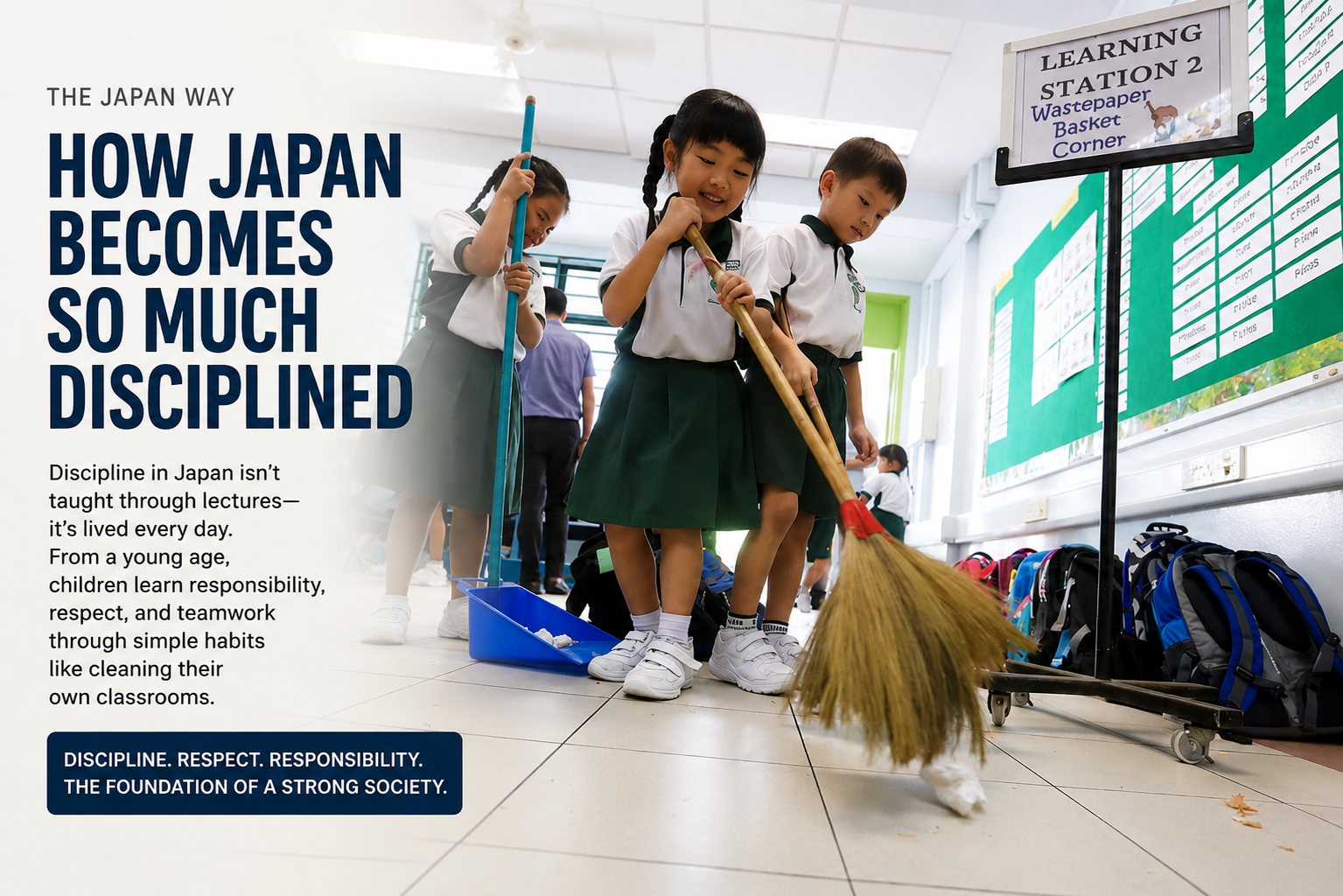
It starts when a child is four years old. It starts in kindergarten. And it starts, of all things, with a broom.
What Japanese Kindergarten Actually Looks Like
Most of the world thinks of kindergarten as a place where children are gently introduced to numbers and letters, given some crayons, and sent home with glitter on their foreheads. In Japan, kindergarten — called yochien — is something completely different in its soul, even if it looks similar on the outside.
Japanese kindergarten is not about academics. Not even slightly. There is no pressure to read early, no anxiety about falling behind, no tests. What there is — what is woven into every single part of the school day — is the patient, careful, deliberate work of teaching a small human being how to live alongside other human beings.
From the very first week, children are introduced to a concept called meiwaku. It does not translate perfectly, but the closest English gets is something like: do not be a burden to others. Do not make your existence someone else’s problem. Think about how your actions land on the people around you.
Now before you think this sounds cold or restrictive — it is not. It is taught with enormous warmth. Teachers do not punish children for meiwaku. They help children feel it. They encourage kids to imagine: how does the other person feel right now? If you leave your shoes in the middle of the hallway, someone has to move them. That someone has feelings. That someone has a day. Think about them.
This is emotional imagination. And Japanese kindergartens spend years cultivating it before they ever teach a child to add or subtract.
There is another word too — omoiyari. Think of it as empathy with legs. It means not just feeling what someone else feels, but actually doing something about it. Noticing the kid who dropped their lunch box and helping them pick it up. Noticing the teacher looks tired and being a little quieter today. Anticipating what is needed before anyone asks.
These are not rules on a poster. They are practiced, every single day, in real situations, with real children, until they become instinct.
The Lunch That Teaches Everything
Here is one of my favourite things about Japanese school culture and I genuinely think it is a small masterpiece of education design.
In Japanese schools, children serve each other’s lunch.
They put on little white coats and hats. They carry the food from the kitchen. They ladle the soup into each other’s bowls. They make sure everyone has enough. Then, before anyone takes a single bite, the whole class says itadakimasu together — a word that roughly means “I humbly receive this,” a moment of gratitude for the farmers who grew the food, the people who cooked it, and the earth that made it possible.
After lunch, the children clean up together. They wipe the tables. They wash their own dishes. They put everything away.
Think about what a child absorbs from this routine, repeated every single school day for years. They learn that food does not just appear — it comes from work, from land, from other people’s hands. They learn that serving someone else is not a lesser job; it is an honourable one. They learn that the space they eat in is their responsibility, not a stranger’s. They learn gratitude — not as a word, but as a daily physical act.
By the time these children are adults, gratitude is not something they remember to feel on special occasions. It is just part of how they move through the world.
Why Are They So Soft-Hearted?
This is the question that gets me most. Because Japanese children are genuinely, noticeably gentle. Not weak — gentle. There is a difference that matters.
A lot of it comes from something called the han system. In Japanese schools, children are divided into small groups of four or five students. These groups do almost everything together. They eat together, clean together, work on projects together, and they are responsible for each other.
If someone in your group is struggling with a task, that is your group’s problem too. If someone is sad, you notice. If someone is falling behind, you help. Success is not individual in Japan’s early education — it is collective. And this changes everything about how children see each other.
Instead of classmates being competition, they become community.
Instead of someone else’s difficulty being irrelevant to you, it becomes your concern.
This is so different from the educational culture of most countries, where from the earliest age children are sorted, ranked, and quietly encouraged to beat each other. Japan’s early education says: you are not here to be better than the child next to you. You are here to grow together.
The kindness that results from this is not performed. It is not the manufactured politeness of someone following a social script. It comes from years of genuine practice — of actually looking out for the people around you and experiencing how good that feels for everyone involved.
The Red Light at 2 AM
Let me come back to that story my friend told me. The man at the midnight traffic light.
In most places in the world, rules are external. They exist because of punishment. You stop at a red light because a camera might catch you, or a policeman might be watching, or another car might hit you. The rule lives outside you.
In Japan, the rule lives inside you.
This is not an accident. It is the result of an educational and cultural approach that, from the very beginning, never just tells children what the rule is — it explains why the rule exists. Who it protects. What it is holding together. What happens to the shared life of a community when that rule falls apart.
A traffic light is not a government order. It is an agreement. A community of people deciding together: we will all stop here, so we can all move safely. The agreement does not expire at midnight when nobody is looking. Because the agreement was never about being watched. It was about something you made with the people who share your streets.
When a rule is a cage, you escape it the moment the lock is gone.
When a rule is a covenant — something you genuinely believe in, something you helped create by being part of the community it protects — you keep it in the dark.
Japan produces people who keep their covenants in the dark. And that is an extraordinary thing.
After the 2011 earthquake and tsunami — one of the worst natural disasters in modern history — there was no looting in Japan. While people had lost their homes, their families, everything they owned, survivors formed quiet, orderly lines to receive food and water. The elderly and children were helped first. Strangers shared what they had with other strangers.
The world watched and genuinely could not understand it. But it was not mysterious. It was just what happens when you spend a generation teaching children that the community is more important than the individual moment of advantage.
Loving Your Country Without Being Told To
Japan’s patriotism is one of the most interesting things about the country, and also one of the most misunderstood.
It is not loud. There are no flags on every front porch, no political speeches about national greatness, no children being told that Japan is better than other countries. Japanese patriotism is something much quieter and, I would argue, much more real.
Every spring, the whole country stops — genuinely stops — to watch cherry blossoms bloom. Families go to parks. Old people sit under the trees with tea. Young people have picnics. Strangers share space with strangers. It is called hanami and it has been happening for over a thousand years.
No government declared it. No politician encouraged it. It just exists, passed down from grandparent to parent to child, because somewhere along the way Japan decided that stopping to notice beauty together is a form of love — love for the land, for the season, for the life you share with the people around you.
A child who grows up doing hanami every single spring, who learns the names of the seasons and the foods that belong to them, who is taught to feel something when the autumn leaves turn red and the snow falls on the mountains — that child does not need a nationalism lecture. The love for their country is already inside them. It grew there naturally, planted by petals and cold mornings and warm bowls of soup in winter.
This is the difference between patriotism and nationalism. Nationalism is when someone tells you your country is great and others are lesser. Patriotism is when you have loved something so deeply and for so long that the idea of anything happening to it breaks your heart a little.
Japan raises patriots, not nationalists. And the distinction matters more than most people realise.
What the Rest of the World Is Missing
I do not think Japan is perfect. It is not. It has its own serious problems — overwork culture that breaks people, social pressures that can suffocate individuality, a complicated relationship with failure. These are real things and they matter.
But there are things Japan is doing that the rest of the world has simply not figured out yet, and they deserve to be said plainly.
The first is this: emotional education is not soft. It is not a nice extra that you add once the real education is done. It is the foundation. A child who knows how to feel what others feel, who knows how to be responsible for shared spaces, who knows how to take pride in their work without ego — that child will outperform a child who can recite facts and solve equations but has no idea how to be a person, every single time.
The second is this: rules work better when people understand them. Fear produces compliance. Understanding produces conscience. A conscience does not need a surveillance camera. A conscience goes to bed with you and wakes up with you and stands at a red light at midnight on an empty street.
The third is this: belonging is not given. It is grown. It grows from shared meals and shared responsibilities and shared seasons. It grows from being told, in a thousand small ways, that this space — this classroom, this street, this country — is yours, and you are responsible for it, and what you do with it matters.
Japan has been saying this to its children for generations.
And its children have been listening.
A Small Closing Thought
There is a word in Japanese — natsukashii. It means a warm, gentle feeling of nostalgia for something you love. Not sadness exactly. More like tenderness. The feeling you get when you see something that belongs to a part of your life that mattered.
I think that is what Japan has managed to give its people, more than anything else.
A feeling of deep, tender belonging to the place and people around them. A sense that the world is not something that happens to you — it is something you are part of, and responsible for, and that is somehow more beautiful because of that responsibility.
The world has a lot to learn from that feeling.
And maybe, just maybe, it starts with giving a small child a broom — and trusting them to know what to do with it.